Understanding Colour Difference: What is Delta E

In industries where colour consistency is critical — from packaging and textiles to plastics, coatings, and automotive — Delta E (ΔE) is the number that quantifies how close colours really are. It transforms subjective visual judgements such as “too pale” or “slightly off” into precise, traceable data.

A ΔE value can be the difference between a product that passes inspection and one that is rejected as “not quite right”. It allows colour quality control teams to quickly understand colour difference, communicate tolerances, and prevent costly errors across global supply chains.

What exactly is ΔE? And why is it essential for colour management in modern manufacturing?
At a Glance: Delta E (ΔE)

ΔE is the universal measure of colour difference. Different industries and applications will set acceptable tolerances.

  • Below 1 → invisible
  • 1–2 → barely noticeable
  • Above 3 → unacceptable in most industries

It helps manufacturers ensure colour consistency, cut waste, and protect product quality across supply chains.

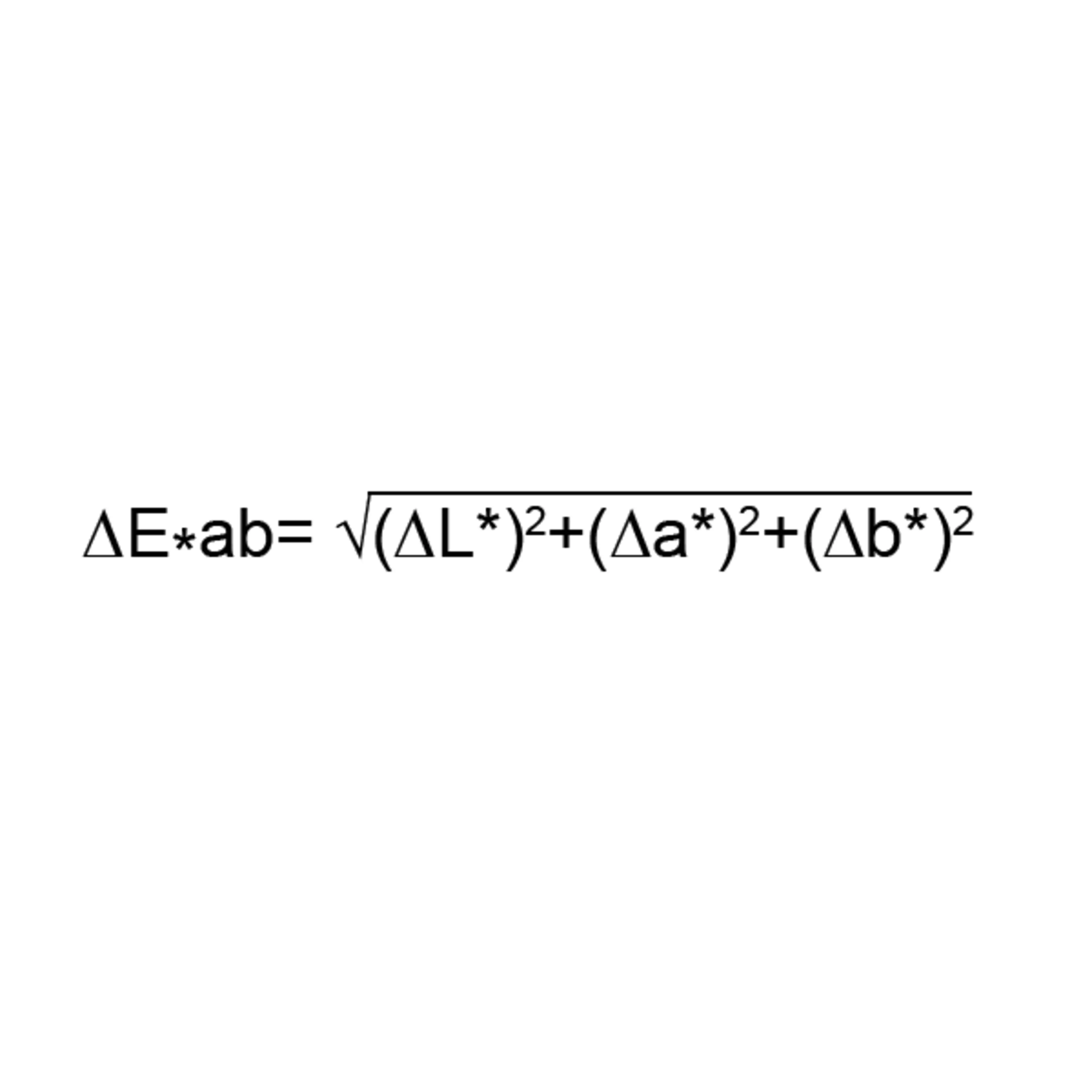
Equation DeltaE

What Is Delta E?

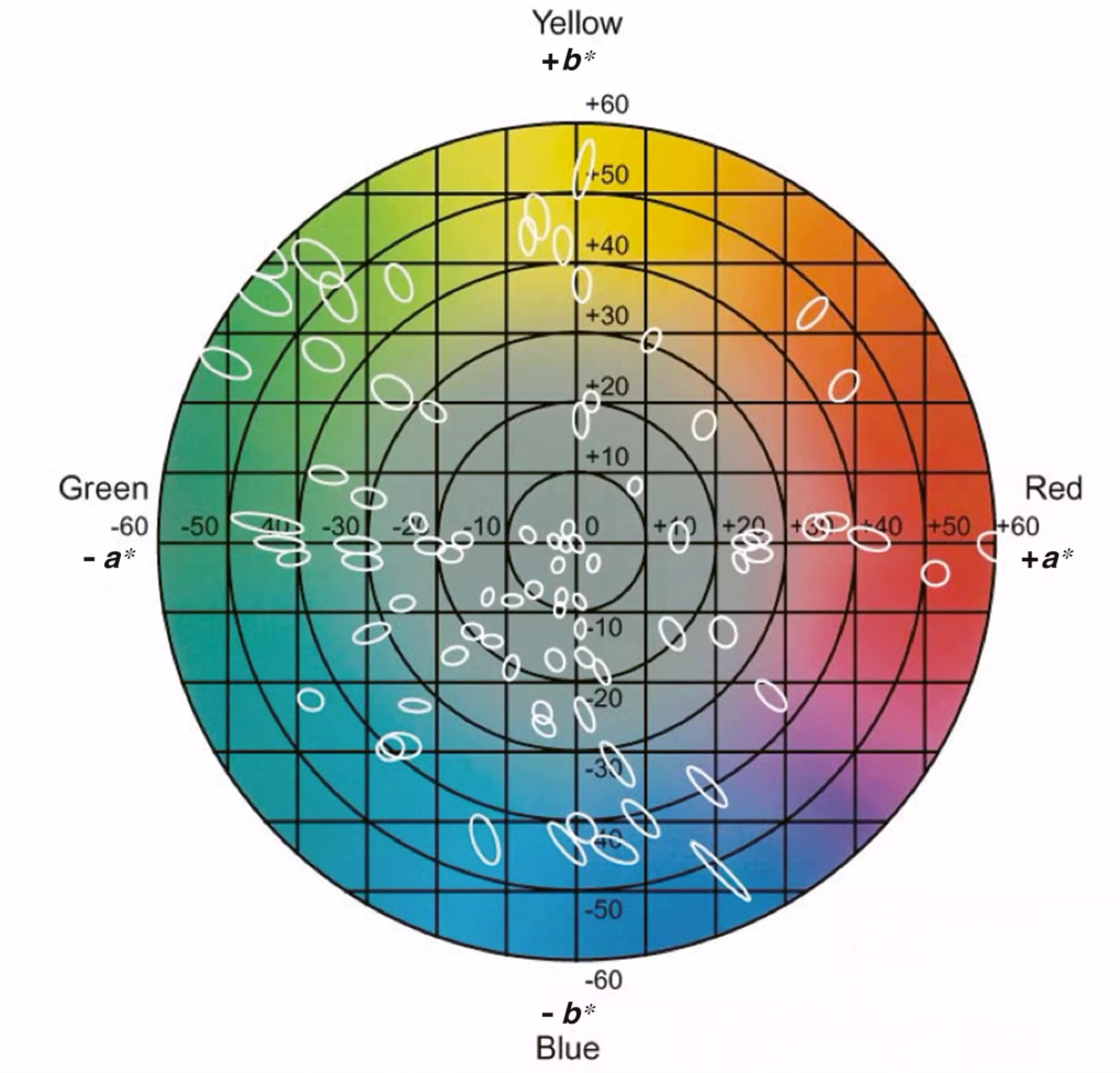
ΔE stands for “Delta Error” — more precisely, difference in colour. It represents the distance between two colours in a defined colour space, most commonly CIELAB (Lab*).

In CIELAB, every colour is described by three coordinates:

  • L* (lightness, from black to white)
  • a* (green to red axis)
  • b* (blue to yellow axis)

The ΔE formula compresses these three-dimensional differences into one easy-to-read value.

This makes ΔE an indispensable shorthand for quality control.

How to interpret ΔE values:

    • ΔE = 0 → Colours are identical.
    • ΔE < 1 → Imperceptible to the human eye.
    • ΔE = 1–2 → Barely noticeable under close inspection.
    • ΔE ≥ 3 → Clearly visible difference, often unacceptable depending on industry.

Tolerance levels differ by application. A luxury cosmetic brand may demand ΔE ≤ 1.0, while an automotive supplier may accept ΔE ≤ 2.0 for internal (non visible) components.

Why Does Delta E Matter?

Visual assessment alone cannot be trusted in professional colour quality control. Lighting conditions, viewing angles, and individual perception all introduce inconsistencies. ΔE provides a reliable benchmark.

Benefits of using ΔE:

  • Removes subjectivity: Eliminates disputes caused by vague terms such as “slightly duller” or “too bright”.
  • Supports tolerance standards: Brands and suppliers often specify maximum ΔE values to guarantee colour uniformity across production runs.
  • Prevents costly waste: Early detection of out-of-tolerance batches avoids scrap, rework, and product returns.
  • Improves global communication: Designers, production teams, and suppliers across different regions can share the same standardised metric.
  • Ensures compliance: In industries such as food packaging or automotive, colour tolerances can be linked not just to aesthetics but also to regulatory requirements.

Which Delta E Formula Should You Use?

ΔE*ab (CIE76)

The original formula. Easy to calculate but does not always align with how the human eye perceives differences.

ΔE00 (CIEDE2000)

The most modern and widely used. It adds weighting factors to ΔL*, ΔC* (chroma), and ΔH* (hue) so the result better matches visual perception.

CIE00 example colour discrimination thresholds

Example colour discrimination thresholds used in CIE ΔE00.

CIE 00 visual colour discrimination thresholds

Why does the Formula Choice Matter

CM-5 Display

Why does this matter? Because the human eye does not see colour differences equally across all shades. Differences in highly saturated colours are harder to distinguish, while some hues (like blues and greens) are perceived with greater sensitivity. ΔE00 accounts for this, making it more accurate for industries where subtle differences are critical, such as cosmetics, textiles, and automotive coatings.

Konica Minolta instruments, such as the CM-36dG or CM-26dG, calculate both ΔEab and ΔE00 values. These spectrophotometers also provide deeper insights, including ΔL, Δa*, Δb*, and full spectral reflectance data, helping users not only measure “how much” difference exists but also diagnose “why” it exists.

An Example

Imagine two red plastic casings from different production batches. To the naked eye they might appear close, but a spectrophotometer measurement reveals:

  • Batch A: L* = 45.0, a* = 48.5, b* = 15.0
  • Batch B: L* = 48.2, a* = 44.1, b* = 15.3

ΔE00 = 3.1

The colour difference is mainly in L* (lightness) and a* (red-green). Batch B is lighter and less red. If the brand specifies ΔE ≤ 2.0, Batch B fails, triggering rework or colour correction.

Now consider another scenario: two packaging films look identical in daylight but mismatch badly under supermarket lighting. This is metamerism — when colours match under one light source but diverge under another. Here, ΔE values measured under multiple illuminants highlight the risk before products reach consumers.

Limitations of Delta E: Going Beyond the Number

While ΔE is a valuable indicator, it only tells you the size of the difference, not its nature. That’s why quality engineers often dig deeper and investigate the individual axis if the Delta E value drifts out of tolerance:

  • ΔL* → Too light or too dark
  • Δa* → Too green or too red
  • Δb* → Too blue or too yellow

It may also be necessary to investigate the Spectral reflectance curves of the target and the sample to reveal wavelength-specific mismatches that could be linked to pigment, substrate, or process changes.

Surface gloss and texture can also affect ΔE readings. Most d:8 instruments allow measurement of SCI (specular component included) or SCE (specular component excluded) modes to evaluate colour both with and without the influence of surface reflection. Indeed many instruments can measure both conditions in a single measurement.

For example, if ΔL* has the largest deviation, the cause might be insufficient pigment or a change in surface finish. If Δa* is the issue, the red pigment dosage or grade may need adjusting.

Conclusion

Delta E is more than a mathematical value. It is a universal language of colour quality, allowing industries worldwide to maintain consistency, cut waste, and protect brand integrity.

Whether you’re a designer, quality engineer, or production manager, understanding and applying ΔE in your workflow ensures:

  • Reliable colour consistency across products and batches
  • Clearer communication with suppliers and partners
  • Reduced risk of costly rework and batch rejection

If colour matters in your process, ΔE is the metric you cannot afford to ignore.

Further Reading

CIE / ISO Standard: Colorimetry Part 6 (CIEDE2000 Colour-Difference Formula)

CIE 2000 color difference formula: CIEDE2000 — SPIE Proceedings

Share:

Contact

Ewald Rath
Ewald Rath

Colour & Appearance Technology Manager EMEA